11. August 2026Andrei Muntean16 min read
How to Sell a Business in the UK in 2026
How to Sell a Business in the UK in 2026 – The Complete Guide for Business Owners
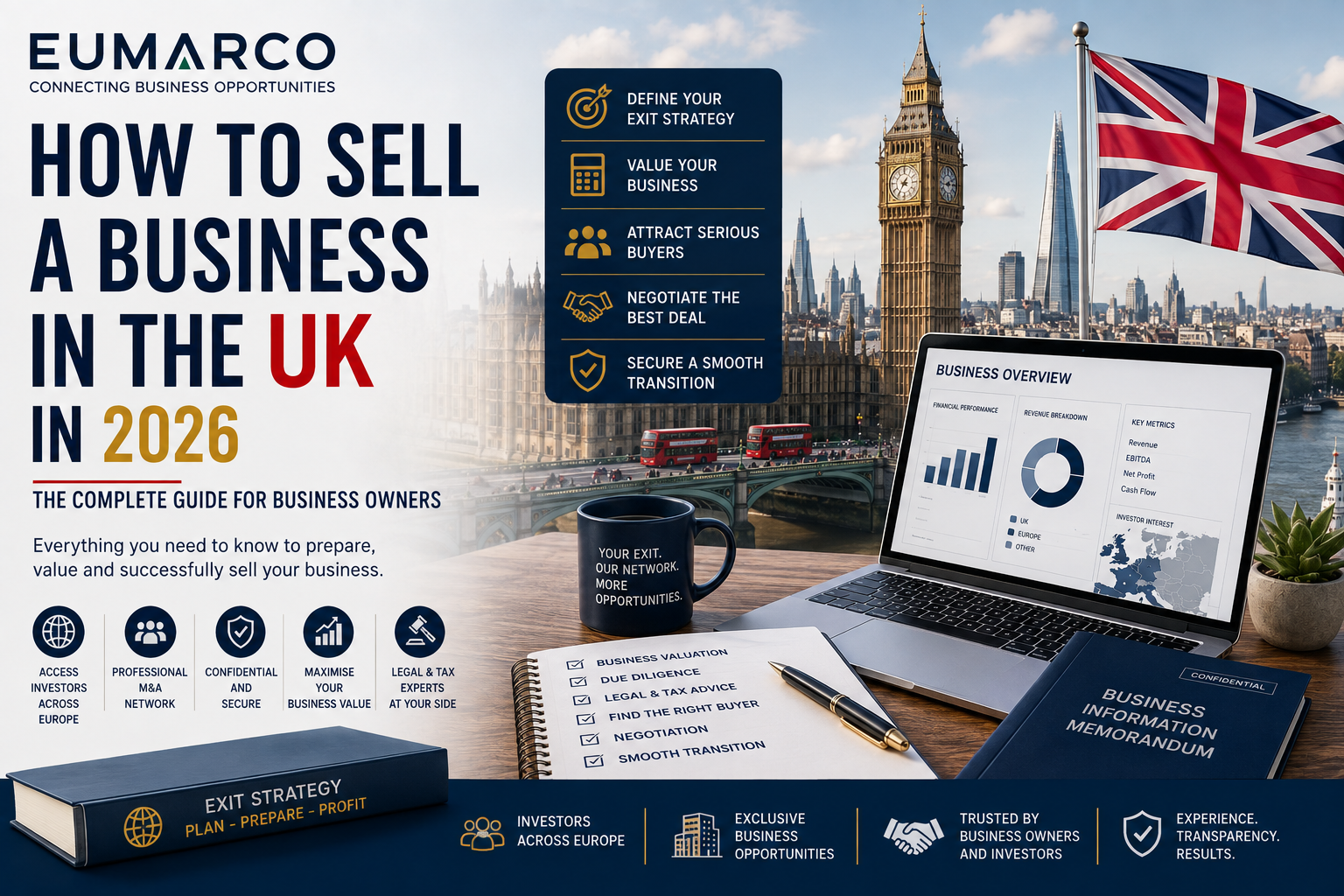
How to Sell a Business in the UK in 2026 – The Complete Guide for Business Owners
Author: Andrei Muntean
Last updated: 2026
Reading time: Approximately 15 minutes
________________________________________
How to Sell a Business in the UK in 2026
Selling a business is one of the most significant decisions an entrepreneur will ever make.
For some, it marks the successful conclusion of years of hard work. For others, it is an opportunity to retire, launch a new venture or realise the value they have built over many years.
Whatever the reason, selling a business requires far more than simply finding a buyer.
A successful transaction depends on careful preparation, realistic valuation and access to the right investors.
In this guide, you'll learn how to prepare your business for sale, increase its value and attract qualified buyers from both the UK and across Europe.
________________________________________
Why are more UK business owners selling their companies?
Across the United Kingdom, thousands of business owners are approaching retirement or considering their long-term exit strategy.
Many successful companies have been built over decades and now face one important question:
Who will take the business forward?
In many cases there is no family successor, while others simply want to pursue new opportunities or enjoy retirement.
At the same time, demand from investors continues to grow.
Private investors, larger companies and investment funds are actively looking for profitable UK businesses with strong growth potential.
Common reasons for selling include:
• Retirement
• No succession plan
• Starting a new venture
• Attracting a strategic investor
• Business restructuring
• Releasing capital for future investments
Having a clear reason for selling helps build trust with potential buyers from the very beginning.
________________________________________
Why preparation matters
Many business owners believe the market will automatically determine the value of their business.
In reality, experienced investors analyse every aspect of a company before making an offer.
They are not simply buying a business.
They are investing in:
• a proven business model;
• recurring revenue;
• loyal customers;
• experienced employees;
• operational systems;
• future growth potential.
The better prepared your business is, the more confidence it inspires—and the greater your chances of achieving a successful sale.
________________________________________
Benefits of preparing your business before selling
Preparing your business well in advance offers several important advantages.
It can:
✔ increase the perceived value of your business;
✔ attract higher-quality buyers;
✔ speed up negotiations;
✔ simplify the Due Diligence process;
✔ reduce transaction risks;
✔ strengthen your negotiating position.
For many owners, preparation can make the difference between an average deal and an outstanding one.
________________________________________
Step 1 – Define your exit strategy
One of the first questions any serious buyer will ask is:
"Why are you selling your business?"
There is no perfect answer.
What matters is that your explanation is honest, consistent and commercially sound.
Typical reasons include:
• Retirement
• Lack of succession
• Starting another business
• Lifestyle changes
• Bringing in a strategic investor
• Diversifying investments
Professional buyers understand these reasons.
Unclear or inconsistent answers, however, often raise unnecessary concerns.
________________________________________
Step 2 – What is your business really worth?
This is arguably the most important question throughout the entire sales process.
Many owners value their business based on years of hard work or personal sacrifice.
Investors take a different approach.
They focus primarily on the company's future earning potential.
Typical evaluation criteria include:
• Revenue
• EBITDA
• Net profit
• Cash flow
• Customer base
• Existing contracts
• Business assets
• Market position
• Competitive advantages
• Future growth opportunities
A professional valuation provides a strong foundation for successful negotiations.
________________________________________
What determines the value of a business?
Every company is different, but several factors consistently influence valuation.
Profitability
Businesses with stable and predictable profits are generally more attractive.
Customer Base
A diversified customer portfolio reduces investment risk.
Management Team
Companies that operate successfully without relying entirely on the owner are significantly more valuable.
Business Processes
Well-documented systems and procedures make ownership transfer much easier.
Brand Reputation
A trusted brand often represents one of a company's strongest competitive advantages.
Growth Potential
Investors buy future opportunities—not just current performance.
Businesses with clear expansion opportunities in the UK or across Europe typically attract greater investor interest.
________________________________________
Eumarco's Advice
Before putting your business on the market, invest time in proper preparation.
A realistic valuation, professional presentation and clear sales strategy can significantly improve both the quality of buyers and the outcome of the transaction.
Business Succession in the UK – Planning Your Exit Before It's Too Late
Across the United Kingdom, thousands of business owners are approaching retirement or considering what comes next for their company.
For many entrepreneurs, their business represents decades of commitment, long working hours and personal sacrifice.
Yet one important question is often postponed until it becomes urgent:
Who will take over the business when you decide to step away?
In many cases there is no family successor, or the next generation has chosen a different career path.
Without a clear succession plan, owners often believe they have only two options:
• continue running the business longer than they intended;
• close the company.
Fortunately, there is another option.
Selling a well-established business can protect everything that has been built over the years while ensuring continuity for employees, customers and suppliers.
________________________________________
Well-managed businesses are in demand
Many business owners believe that only large corporations attract investors.
The reality is quite different.
Private equity firms, strategic buyers and private investors actively search for profitable SMEs with:
• recurring revenue;
• experienced employees;
• loyal customers;
• efficient business processes;
• a strong reputation;
• opportunities for future growth.
Buying an existing business is often faster and less risky than building one from scratch.
________________________________________
Exit planning should begin early
One of the biggest mistakes owners make is waiting until retirement is only a few months away.
The earlier you begin preparing your exit, the greater your flexibility.
Starting the process 12–24 months in advance gives you time to:
• improve financial performance;
• organise documentation;
• strengthen management;
• increase business value;
• identify potential buyers.
A planned exit almost always produces better results than a rushed sale.
________________________________________
The UK remains attractive to international investors
Despite changes in the business environment over recent years, the United Kingdom continues to attract investors from around the world.
Its mature legal system, strong financial markets and internationally recognised business environment make UK companies attractive acquisition targets.
Many European and international businesses view acquiring an existing UK company as an efficient way to expand into the British market.
________________________________________
Brexit changed the process—not the opportunities
Brexit has undoubtedly changed certain legal and commercial procedures.
However, it has not reduced investor interest in quality British businesses.
Companies with strong financial performance, experienced management teams and scalable business models continue to attract buyers from across Europe and beyond.
Today, cross-border acquisitions remain an important part of the UK M&A market.
________________________________________
A European platform creates more opportunities
Years ago, finding international buyers often meant contacting advisors in multiple countries individually.
Today, specialised platforms make this process significantly easier.
By listing a business on Eumarco, UK business owners can increase their visibility not only among domestic investors but also among qualified buyers across Europe.
Instead of relying on a limited local network, companies can present themselves to investors from Germany, Spain, Italy, the Netherlands, Romania and many other European markets.
Greater visibility often leads to more enquiries, stronger competition among buyers and better negotiating opportunities.
________________________________________
Practical Example
Imagine a manufacturing company based in Birmingham that has been operating successfully for more than twenty-five years.
The owner plans to retire, but none of the family members wishes to continue running the business.
Initially, the company is marketed only within the UK.
Interest is limited and offers remain below expectations.
The owner then decides to publish the business on Eumarco.
Within weeks, enquiries arrive not only from British investors but also from:
• a German industrial group seeking to expand into the UK market;
• a Dutch investment fund specialising in manufacturing businesses;
• an Italian company looking to establish a stronger presence in Northern Europe.
Through Eumarco's professional network, the owner also connects with M&A advisors, solicitors, tax specialists and valuation experts who support the transaction from beginning to end.
As a result, the business gains broader international exposure and significantly increases its chances of finding the right buyer.
Note: This example is fictional and intended solely to illustrate how international business transactions can take place through a European platform. Every transaction is unique and depends on the characteristics of the business, investor interest and market conditions.
________________________________________
Step 3 – Prepare Your Business for Due Diligence
Once a serious buyer expresses interest in your business, one of the most important stages of the transaction begins: Due Diligence.
Many business owners only hear this term when negotiations are already underway. In reality, preparation should begin long before your business is placed on the market.
A well-prepared business creates confidence, demonstrates professionalism and helps speed up the entire transaction.
________________________________________
What is Due Diligence?
Due Diligence is the process through which a potential buyer carefully reviews every important aspect of your business before completing the acquisition.
The objective is not to find problems wherever possible.
Instead, buyers want to verify that the information provided is accurate, complete and reliable.
During Due Diligence, investors typically examine:
• financial performance;
• tax compliance;
• legal documentation;
• customer and supplier contracts;
• operational processes;
• intellectual property;
• employee structure;
• potential commercial risks.
The better organised your documentation is, the smoother the process becomes.
________________________________________
What Documents Should You Prepare?
Although every transaction is different, buyers usually request similar information.
Corporate Documentation
Prepare documents such as:
• Certificate of Incorporation
• Articles of Association
• Companies House records
• Shareholder information
• Key commercial agreements
• Licences and regulatory approvals
________________________________________
Financial Information
Professional buyers will normally request:
• Annual Accounts
• Profit & Loss Statements
• Balance Sheets
• Cash Flow Statements
• Management Accounts
• Debt Schedule
• Fixed Asset Register
Accurate financial information allows investors to assess the true performance of the business.
________________________________________
Operational Information
Buyers also want to understand how the business operates.
Useful documents include:
• organisational structure;
• operational procedures;
• key employment contracts;
• software systems;
• supplier agreements;
• maintenance contracts.
A business that operates independently of its owner is generally more attractive to investors.
________________________________________
Intellectual Property
If your business owns valuable intellectual property, ensure it is properly documented.
Examples include:
• trademarks;
• patents;
• proprietary software;
• websites and domain names;
• customer databases;
• copyrights.
For many companies, intellectual property represents a significant proportion of overall business value.
________________________________________
Use a Virtual Data Room
Professional M&A transactions commonly use a Virtual Data Room (VDR).
A VDR is a secure online environment where all documents are stored and shared with authorised buyers.
Benefits include:
• improved security;
• faster document sharing;
• better organisation;
• controlled access;
• greater confidence during Due Diligence.
Preparing a professional Data Room demonstrates that your business is ready for acquisition.
________________________________________
Step 4 – Who Is Your Ideal Buyer?
Not every buyer is looking for the same type of business.
Understanding who your ideal buyer is allows you to present your company more effectively and negotiate from a stronger position.
________________________________________
Strategic Buyers
Strategic buyers are usually companies operating in the same industry or a complementary sector.
Their objective is to grow through acquisition.
Typical motivations include:
• expanding into new markets;
• increasing market share;
• acquiring new customers;
• strengthening product or service offerings;
• achieving operational synergies.
Because acquisitions create strategic value, these buyers are often prepared to pay premium prices.
________________________________________
Private Equity & Investment Funds
Financial investors focus primarily on future returns.
They typically evaluate:
• profitability;
• EBITDA growth;
• scalability;
• management quality;
• exit opportunities;
• long-term investment potential.
________________________________________
Individual Entrepreneurs
Many experienced entrepreneurs choose to acquire an established business instead of starting one from scratch.
They generally look for:
• stable recurring revenue;
• loyal customers;
• experienced staff;
• proven business systems;
• strong local reputation.
________________________________________
Where Can You Find Serious Buyers?
Finding qualified buyers remains one of the biggest challenges for business owners.
Traditionally, companies relied on local business brokers or personal networks.
Today, European digital platforms provide access to a much broader audience of qualified investors.
________________________________________
Why List Your Business on Eumarco?
Eumarco is more than a business listing platform.
It is a European marketplace designed to connect:
• business owners;
• private investors;
• investment funds;
• M&A advisors;
• solicitors;
• tax specialists;
• valuation experts;
• Due Diligence professionals.
This means a business based in Manchester, Birmingham or London can become visible not only to UK buyers but also to investors across Germany, Spain, Italy, the Netherlands, Romania and many other European markets.
Greater visibility creates more opportunities—and more opportunities often lead to better outcomes.
________________________________________
How Should You Present Your Business?
First impressions matter.
A professional business profile should include:
✔ A clear business description
✔ Products and services
✔ Competitive advantages
✔ Key financial highlights
✔ Reason for sale
✔ Future growth opportunities
✔ Professional images
✔ Enough information to attract interest without revealing confidential details.
________________________________________
Eumarco's Advice
Don't try to impress buyers with unrealistic promises.
Professional investors value transparency, preparation and credibility far more than exaggerated claims.
Step 5 – Negotiation Is About More Than Price
When a serious buyer enters the process, negotiations begin.
Many owners believe the highest offer is automatically the best offer.
In reality, successful business transactions involve many other factors, including:
• payment structure;
• completion timetable;
• transition period;
• seller involvement after completion;
• warranties and indemnities;
• assets included in the sale;
• retention of key employees;
• conditions required before completion.
In many cases, a slightly lower offer with clearer terms and lower execution risk may deliver a better overall outcome.
________________________________________
Trust Drives Successful Transactions
One of the most valuable assets during negotiations is trust.
Attempting to hide financial issues, operational weaknesses or legal disputes rarely benefits the seller.
Professional investors will identify most risks during Due Diligence.
Transparency, honesty and preparation build confidence and significantly improve the likelihood of completing a successful transaction.
The Most Common Mistakes When Selling a Business
Selling a business is often a once-in-a-lifetime event.
Even highly successful companies can lose value if common mistakes are made during the sales process.
Understanding these pitfalls can help business owners maximise value and complete a smoother transaction.
________________________________________
1. Overvaluing the Business
One of the biggest mistakes business owners make is attaching emotional value to their company.
Years of hard work, personal sacrifice and financial investment are important—but buyers evaluate businesses differently.
Professional investors focus on:
• profitability;
• future growth potential;
• market position;
• business risks;
• recurring revenue;
• scalability.
An unrealistic asking price can discourage serious buyers before discussions even begin.
Eumarco's Advice
Base your valuation on professional analysis and market data rather than personal expectations.
________________________________________
2. Leaving the Sale Until the Last Minute
Many owners begin thinking about selling only when retirement is approaching or unexpected circumstances arise.
Unfortunately, urgency often weakens a seller's negotiating position.
Preparing your exit strategy one or two years in advance gives you time to improve financial performance, organise documentation and increase buyer confidence.
________________________________________
3. Poor Documentation
Investors expect accurate and well-organised information.
Missing financial records, outdated contracts or incomplete documentation can slow negotiations and reduce confidence.
Well-prepared businesses usually complete transactions more efficiently.
________________________________________
4. Hiding Problems
Every business has challenges.
Attempting to hide them rarely succeeds.
Experienced buyers will normally identify operational, financial or legal issues during Due Diligence.
Transparency builds credibility and strengthens negotiations.
________________________________________
5. Letting Emotions Drive Negotiations
For an owner, the business may represent a lifetime of work.
For an investor, it represents an investment opportunity.
Successful negotiations are based on facts, data and realistic expectations rather than emotions.
________________________________________
6. Accepting the First Offer
Receiving an offer is encouraging—but it does not necessarily mean it is the best available option.
Evaluating multiple buyers often leads to:
• stronger negotiating power;
• better commercial terms;
• a higher overall transaction value;
• a better long-term future for the business.
________________________________________
7. Ignoring Transition Planning
A successful sale does not end on Completion Day.
Many transactions include a structured transition period during which the previous owner supports the new management.
This helps maintain customer relationships, employee confidence and operational continuity.
________________________________________
8. Overlooking Tax Planning
Every business sale has tax implications.
Seeking professional tax advice early in the process can help avoid unexpected liabilities and improve the overall outcome of the transaction.
________________________________________
9. Sharing Confidential Information Too Early
Sensitive commercial information should only be shared with qualified buyers after a Non-Disclosure Agreement (NDA) has been signed.
Protecting confidential information safeguards both the business and the sales process.
________________________________________
10. Trying to Handle Everything Alone
Selling a business involves legal, financial, tax and commercial considerations.
Working with experienced professionals often reduces risk and improves the likelihood of achieving a successful outcome.
________________________________________
Business Sale Checklist
Before placing your business on the market, review the following checklist.
Business Strategy
☐ I have clearly defined why I want to sell.
☐ I understand my objectives.
☐ I know what type of buyer I am looking for.
________________________________________
Documentation
☐ Financial statements are up to date.
☐ Companies House records are accurate.
☐ Key contracts are organised.
☐ Tax documentation is complete.
☐ Business assets have been documented.
________________________________________
Business Valuation
☐ I have obtained a realistic valuation.
☐ I understand my company's strengths.
☐ I can justify the asking price with evidence.
________________________________________
Sale Preparation
☐ A professional business profile has been prepared.
☐ An NDA is ready.
☐ Due Diligence documentation has been organised.
☐ My negotiation strategy is clear.
________________________________________
Why Choose Eumarco?
Business acquisitions are becoming increasingly international.
Today, the ideal buyer may not be located in the same city—or even the same country.
Finding qualified investors, legal advisors and M&A professionals across multiple European markets can be both time-consuming and expensive.
Eumarco was created to simplify this process.
Our platform connects:
• business owners;
• private investors;
• investment funds;
• M&A advisors;
• solicitors;
• tax consultants;
• business valuation experts;
• Due Diligence specialists;
• franchise professionals.
Instead of searching country by country, Eumarco provides access to a growing European business network through a single platform.
Our goal is simple:
To connect business owners with the right investors—anywhere in Europe.
________________________________________
Conclusion
Selling a business is more than a financial transaction.
It is the transfer of years of experience, commitment and entrepreneurship to a new owner.
Careful preparation, realistic expectations and access to the right investors can significantly improve the outcome of any transaction.
Whether you are planning retirement, pursuing a new opportunity or preparing a long-term exit strategy, taking the right approach today can help maximise the value of everything you have built.
________________________________________
Publish Your Business on Eumarco
If you are considering selling your business, visibility is the first step.
With Eumarco you can:
• present your business to investors across Europe;
• connect with experienced M&A professionals;
• access legal and tax experts;
• increase your exposure beyond the UK market.
➡ Create your free Eumarco account and introduce your business to a European network of qualified investors.
________________________________________
Frequently Asked Questions (FAQ)
How long does it take to sell a business?
Every transaction is different. Depending on the size of the business, the sector and investor interest, the process may take anywhere from several months to over a year.
________________________________________
Can I sell my business to an overseas buyer?
Yes. Cross-border acquisitions are common, and many UK businesses are acquired by European or international investors.
________________________________________
Do I need a professional business valuation?
Although not mandatory, a professional valuation provides a realistic basis for negotiations and helps establish credibility with buyers.
________________________________________
What documents will buyers request?
Typically, buyers review financial statements, legal documentation, tax records, contracts, operational information and details of key assets.
________________________________________
How is confidential information protected?
Sensitive information is normally shared only after a Non-Disclosure Agreement (NDA) has been signed and only with qualified potential buyers.
________________________________________
About the Author
Andrei Muntean is the founder of Eumarco, a European platform specialising in business sales, investor matching and business succession solutions.
After building, managing and successfully selling his own company, he created Eumarco with a clear mission: to simplify business acquisitions across Europe by connecting entrepreneurs, investors and specialist advisors through a single platform.
The articles published on the Eumarco Blog combine practical entrepreneurial experience with knowledge of the European M&A market, helping business owners and investors make informed decisions.
Author: Andrei Muntean
Last updated: 2026
Reading time: Approximately 15 minutes
________________________________________
How to Sell a Business in the UK in 2026
Selling a business is one of the most significant decisions an entrepreneur will ever make.
For some, it marks the successful conclusion of years of hard work. For others, it is an opportunity to retire, launch a new venture or realise the value they have built over many years.
Whatever the reason, selling a business requires far more than simply finding a buyer.
A successful transaction depends on careful preparation, realistic valuation and access to the right investors.
In this guide, you'll learn how to prepare your business for sale, increase its value and attract qualified buyers from both the UK and across Europe.
________________________________________
Why are more UK business owners selling their companies?
Across the United Kingdom, thousands of business owners are approaching retirement or considering their long-term exit strategy.
Many successful companies have been built over decades and now face one important question:
Who will take the business forward?
In many cases there is no family successor, while others simply want to pursue new opportunities or enjoy retirement.
At the same time, demand from investors continues to grow.
Private investors, larger companies and investment funds are actively looking for profitable UK businesses with strong growth potential.
Common reasons for selling include:
• Retirement
• No succession plan
• Starting a new venture
• Attracting a strategic investor
• Business restructuring
• Releasing capital for future investments
Having a clear reason for selling helps build trust with potential buyers from the very beginning.
________________________________________
Why preparation matters
Many business owners believe the market will automatically determine the value of their business.
In reality, experienced investors analyse every aspect of a company before making an offer.
They are not simply buying a business.
They are investing in:
• a proven business model;
• recurring revenue;
• loyal customers;
• experienced employees;
• operational systems;
• future growth potential.
The better prepared your business is, the more confidence it inspires—and the greater your chances of achieving a successful sale.
________________________________________
Benefits of preparing your business before selling
Preparing your business well in advance offers several important advantages.
It can:
✔ increase the perceived value of your business;
✔ attract higher-quality buyers;
✔ speed up negotiations;
✔ simplify the Due Diligence process;
✔ reduce transaction risks;
✔ strengthen your negotiating position.
For many owners, preparation can make the difference between an average deal and an outstanding one.
________________________________________
Step 1 – Define your exit strategy
One of the first questions any serious buyer will ask is:
"Why are you selling your business?"
There is no perfect answer.
What matters is that your explanation is honest, consistent and commercially sound.
Typical reasons include:
• Retirement
• Lack of succession
• Starting another business
• Lifestyle changes
• Bringing in a strategic investor
• Diversifying investments
Professional buyers understand these reasons.
Unclear or inconsistent answers, however, often raise unnecessary concerns.
________________________________________
Step 2 – What is your business really worth?
This is arguably the most important question throughout the entire sales process.
Many owners value their business based on years of hard work or personal sacrifice.
Investors take a different approach.
They focus primarily on the company's future earning potential.
Typical evaluation criteria include:
• Revenue
• EBITDA
• Net profit
• Cash flow
• Customer base
• Existing contracts
• Business assets
• Market position
• Competitive advantages
• Future growth opportunities
A professional valuation provides a strong foundation for successful negotiations.
________________________________________
What determines the value of a business?
Every company is different, but several factors consistently influence valuation.
Profitability
Businesses with stable and predictable profits are generally more attractive.
Customer Base
A diversified customer portfolio reduces investment risk.
Management Team
Companies that operate successfully without relying entirely on the owner are significantly more valuable.
Business Processes
Well-documented systems and procedures make ownership transfer much easier.
Brand Reputation
A trusted brand often represents one of a company's strongest competitive advantages.
Growth Potential
Investors buy future opportunities—not just current performance.
Businesses with clear expansion opportunities in the UK or across Europe typically attract greater investor interest.
________________________________________
Eumarco's Advice
Before putting your business on the market, invest time in proper preparation.
A realistic valuation, professional presentation and clear sales strategy can significantly improve both the quality of buyers and the outcome of the transaction.
Business Succession in the UK – Planning Your Exit Before It's Too Late
Across the United Kingdom, thousands of business owners are approaching retirement or considering what comes next for their company.
For many entrepreneurs, their business represents decades of commitment, long working hours and personal sacrifice.
Yet one important question is often postponed until it becomes urgent:
Who will take over the business when you decide to step away?
In many cases there is no family successor, or the next generation has chosen a different career path.
Without a clear succession plan, owners often believe they have only two options:
• continue running the business longer than they intended;
• close the company.
Fortunately, there is another option.
Selling a well-established business can protect everything that has been built over the years while ensuring continuity for employees, customers and suppliers.
________________________________________
Well-managed businesses are in demand
Many business owners believe that only large corporations attract investors.
The reality is quite different.
Private equity firms, strategic buyers and private investors actively search for profitable SMEs with:
• recurring revenue;
• experienced employees;
• loyal customers;
• efficient business processes;
• a strong reputation;
• opportunities for future growth.
Buying an existing business is often faster and less risky than building one from scratch.
________________________________________
Exit planning should begin early
One of the biggest mistakes owners make is waiting until retirement is only a few months away.
The earlier you begin preparing your exit, the greater your flexibility.
Starting the process 12–24 months in advance gives you time to:
• improve financial performance;
• organise documentation;
• strengthen management;
• increase business value;
• identify potential buyers.
A planned exit almost always produces better results than a rushed sale.
________________________________________
The UK remains attractive to international investors
Despite changes in the business environment over recent years, the United Kingdom continues to attract investors from around the world.
Its mature legal system, strong financial markets and internationally recognised business environment make UK companies attractive acquisition targets.
Many European and international businesses view acquiring an existing UK company as an efficient way to expand into the British market.
________________________________________
Brexit changed the process—not the opportunities
Brexit has undoubtedly changed certain legal and commercial procedures.
However, it has not reduced investor interest in quality British businesses.
Companies with strong financial performance, experienced management teams and scalable business models continue to attract buyers from across Europe and beyond.
Today, cross-border acquisitions remain an important part of the UK M&A market.
________________________________________
A European platform creates more opportunities
Years ago, finding international buyers often meant contacting advisors in multiple countries individually.
Today, specialised platforms make this process significantly easier.
By listing a business on Eumarco, UK business owners can increase their visibility not only among domestic investors but also among qualified buyers across Europe.
Instead of relying on a limited local network, companies can present themselves to investors from Germany, Spain, Italy, the Netherlands, Romania and many other European markets.
Greater visibility often leads to more enquiries, stronger competition among buyers and better negotiating opportunities.
________________________________________
Practical Example
Imagine a manufacturing company based in Birmingham that has been operating successfully for more than twenty-five years.
The owner plans to retire, but none of the family members wishes to continue running the business.
Initially, the company is marketed only within the UK.
Interest is limited and offers remain below expectations.
The owner then decides to publish the business on Eumarco.
Within weeks, enquiries arrive not only from British investors but also from:
• a German industrial group seeking to expand into the UK market;
• a Dutch investment fund specialising in manufacturing businesses;
• an Italian company looking to establish a stronger presence in Northern Europe.
Through Eumarco's professional network, the owner also connects with M&A advisors, solicitors, tax specialists and valuation experts who support the transaction from beginning to end.
As a result, the business gains broader international exposure and significantly increases its chances of finding the right buyer.
Note: This example is fictional and intended solely to illustrate how international business transactions can take place through a European platform. Every transaction is unique and depends on the characteristics of the business, investor interest and market conditions.
________________________________________
Step 3 – Prepare Your Business for Due Diligence
Once a serious buyer expresses interest in your business, one of the most important stages of the transaction begins: Due Diligence.
Many business owners only hear this term when negotiations are already underway. In reality, preparation should begin long before your business is placed on the market.
A well-prepared business creates confidence, demonstrates professionalism and helps speed up the entire transaction.
________________________________________
What is Due Diligence?
Due Diligence is the process through which a potential buyer carefully reviews every important aspect of your business before completing the acquisition.
The objective is not to find problems wherever possible.
Instead, buyers want to verify that the information provided is accurate, complete and reliable.
During Due Diligence, investors typically examine:
• financial performance;
• tax compliance;
• legal documentation;
• customer and supplier contracts;
• operational processes;
• intellectual property;
• employee structure;
• potential commercial risks.
The better organised your documentation is, the smoother the process becomes.
________________________________________
What Documents Should You Prepare?
Although every transaction is different, buyers usually request similar information.
Corporate Documentation
Prepare documents such as:
• Certificate of Incorporation
• Articles of Association
• Companies House records
• Shareholder information
• Key commercial agreements
• Licences and regulatory approvals
________________________________________
Financial Information
Professional buyers will normally request:
• Annual Accounts
• Profit & Loss Statements
• Balance Sheets
• Cash Flow Statements
• Management Accounts
• Debt Schedule
• Fixed Asset Register
Accurate financial information allows investors to assess the true performance of the business.
________________________________________
Operational Information
Buyers also want to understand how the business operates.
Useful documents include:
• organisational structure;
• operational procedures;
• key employment contracts;
• software systems;
• supplier agreements;
• maintenance contracts.
A business that operates independently of its owner is generally more attractive to investors.
________________________________________
Intellectual Property
If your business owns valuable intellectual property, ensure it is properly documented.
Examples include:
• trademarks;
• patents;
• proprietary software;
• websites and domain names;
• customer databases;
• copyrights.
For many companies, intellectual property represents a significant proportion of overall business value.
________________________________________
Use a Virtual Data Room
Professional M&A transactions commonly use a Virtual Data Room (VDR).
A VDR is a secure online environment where all documents are stored and shared with authorised buyers.
Benefits include:
• improved security;
• faster document sharing;
• better organisation;
• controlled access;
• greater confidence during Due Diligence.
Preparing a professional Data Room demonstrates that your business is ready for acquisition.
________________________________________
Step 4 – Who Is Your Ideal Buyer?
Not every buyer is looking for the same type of business.
Understanding who your ideal buyer is allows you to present your company more effectively and negotiate from a stronger position.
________________________________________
Strategic Buyers
Strategic buyers are usually companies operating in the same industry or a complementary sector.
Their objective is to grow through acquisition.
Typical motivations include:
• expanding into new markets;
• increasing market share;
• acquiring new customers;
• strengthening product or service offerings;
• achieving operational synergies.
Because acquisitions create strategic value, these buyers are often prepared to pay premium prices.
________________________________________
Private Equity & Investment Funds
Financial investors focus primarily on future returns.
They typically evaluate:
• profitability;
• EBITDA growth;
• scalability;
• management quality;
• exit opportunities;
• long-term investment potential.
________________________________________
Individual Entrepreneurs
Many experienced entrepreneurs choose to acquire an established business instead of starting one from scratch.
They generally look for:
• stable recurring revenue;
• loyal customers;
• experienced staff;
• proven business systems;
• strong local reputation.
________________________________________
Where Can You Find Serious Buyers?
Finding qualified buyers remains one of the biggest challenges for business owners.
Traditionally, companies relied on local business brokers or personal networks.
Today, European digital platforms provide access to a much broader audience of qualified investors.
________________________________________
Why List Your Business on Eumarco?
Eumarco is more than a business listing platform.
It is a European marketplace designed to connect:
• business owners;
• private investors;
• investment funds;
• M&A advisors;
• solicitors;
• tax specialists;
• valuation experts;
• Due Diligence professionals.
This means a business based in Manchester, Birmingham or London can become visible not only to UK buyers but also to investors across Germany, Spain, Italy, the Netherlands, Romania and many other European markets.
Greater visibility creates more opportunities—and more opportunities often lead to better outcomes.
________________________________________
How Should You Present Your Business?
First impressions matter.
A professional business profile should include:
✔ A clear business description
✔ Products and services
✔ Competitive advantages
✔ Key financial highlights
✔ Reason for sale
✔ Future growth opportunities
✔ Professional images
✔ Enough information to attract interest without revealing confidential details.
________________________________________
Eumarco's Advice
Don't try to impress buyers with unrealistic promises.
Professional investors value transparency, preparation and credibility far more than exaggerated claims.
Step 5 – Negotiation Is About More Than Price
When a serious buyer enters the process, negotiations begin.
Many owners believe the highest offer is automatically the best offer.
In reality, successful business transactions involve many other factors, including:
• payment structure;
• completion timetable;
• transition period;
• seller involvement after completion;
• warranties and indemnities;
• assets included in the sale;
• retention of key employees;
• conditions required before completion.
In many cases, a slightly lower offer with clearer terms and lower execution risk may deliver a better overall outcome.
________________________________________
Trust Drives Successful Transactions
One of the most valuable assets during negotiations is trust.
Attempting to hide financial issues, operational weaknesses or legal disputes rarely benefits the seller.
Professional investors will identify most risks during Due Diligence.
Transparency, honesty and preparation build confidence and significantly improve the likelihood of completing a successful transaction.
The Most Common Mistakes When Selling a Business
Selling a business is often a once-in-a-lifetime event.
Even highly successful companies can lose value if common mistakes are made during the sales process.
Understanding these pitfalls can help business owners maximise value and complete a smoother transaction.
________________________________________
1. Overvaluing the Business
One of the biggest mistakes business owners make is attaching emotional value to their company.
Years of hard work, personal sacrifice and financial investment are important—but buyers evaluate businesses differently.
Professional investors focus on:
• profitability;
• future growth potential;
• market position;
• business risks;
• recurring revenue;
• scalability.
An unrealistic asking price can discourage serious buyers before discussions even begin.
Eumarco's Advice
Base your valuation on professional analysis and market data rather than personal expectations.
________________________________________
2. Leaving the Sale Until the Last Minute
Many owners begin thinking about selling only when retirement is approaching or unexpected circumstances arise.
Unfortunately, urgency often weakens a seller's negotiating position.
Preparing your exit strategy one or two years in advance gives you time to improve financial performance, organise documentation and increase buyer confidence.
________________________________________
3. Poor Documentation
Investors expect accurate and well-organised information.
Missing financial records, outdated contracts or incomplete documentation can slow negotiations and reduce confidence.
Well-prepared businesses usually complete transactions more efficiently.
________________________________________
4. Hiding Problems
Every business has challenges.
Attempting to hide them rarely succeeds.
Experienced buyers will normally identify operational, financial or legal issues during Due Diligence.
Transparency builds credibility and strengthens negotiations.
________________________________________
5. Letting Emotions Drive Negotiations
For an owner, the business may represent a lifetime of work.
For an investor, it represents an investment opportunity.
Successful negotiations are based on facts, data and realistic expectations rather than emotions.
________________________________________
6. Accepting the First Offer
Receiving an offer is encouraging—but it does not necessarily mean it is the best available option.
Evaluating multiple buyers often leads to:
• stronger negotiating power;
• better commercial terms;
• a higher overall transaction value;
• a better long-term future for the business.
________________________________________
7. Ignoring Transition Planning
A successful sale does not end on Completion Day.
Many transactions include a structured transition period during which the previous owner supports the new management.
This helps maintain customer relationships, employee confidence and operational continuity.
________________________________________
8. Overlooking Tax Planning
Every business sale has tax implications.
Seeking professional tax advice early in the process can help avoid unexpected liabilities and improve the overall outcome of the transaction.
________________________________________
9. Sharing Confidential Information Too Early
Sensitive commercial information should only be shared with qualified buyers after a Non-Disclosure Agreement (NDA) has been signed.
Protecting confidential information safeguards both the business and the sales process.
________________________________________
10. Trying to Handle Everything Alone
Selling a business involves legal, financial, tax and commercial considerations.
Working with experienced professionals often reduces risk and improves the likelihood of achieving a successful outcome.
________________________________________
Business Sale Checklist
Before placing your business on the market, review the following checklist.
Business Strategy
☐ I have clearly defined why I want to sell.
☐ I understand my objectives.
☐ I know what type of buyer I am looking for.
________________________________________
Documentation
☐ Financial statements are up to date.
☐ Companies House records are accurate.
☐ Key contracts are organised.
☐ Tax documentation is complete.
☐ Business assets have been documented.
________________________________________
Business Valuation
☐ I have obtained a realistic valuation.
☐ I understand my company's strengths.
☐ I can justify the asking price with evidence.
________________________________________
Sale Preparation
☐ A professional business profile has been prepared.
☐ An NDA is ready.
☐ Due Diligence documentation has been organised.
☐ My negotiation strategy is clear.
________________________________________
Why Choose Eumarco?
Business acquisitions are becoming increasingly international.
Today, the ideal buyer may not be located in the same city—or even the same country.
Finding qualified investors, legal advisors and M&A professionals across multiple European markets can be both time-consuming and expensive.
Eumarco was created to simplify this process.
Our platform connects:
• business owners;
• private investors;
• investment funds;
• M&A advisors;
• solicitors;
• tax consultants;
• business valuation experts;
• Due Diligence specialists;
• franchise professionals.
Instead of searching country by country, Eumarco provides access to a growing European business network through a single platform.
Our goal is simple:
To connect business owners with the right investors—anywhere in Europe.
________________________________________
Conclusion
Selling a business is more than a financial transaction.
It is the transfer of years of experience, commitment and entrepreneurship to a new owner.
Careful preparation, realistic expectations and access to the right investors can significantly improve the outcome of any transaction.
Whether you are planning retirement, pursuing a new opportunity or preparing a long-term exit strategy, taking the right approach today can help maximise the value of everything you have built.
________________________________________
Publish Your Business on Eumarco
If you are considering selling your business, visibility is the first step.
With Eumarco you can:
• present your business to investors across Europe;
• connect with experienced M&A professionals;
• access legal and tax experts;
• increase your exposure beyond the UK market.
➡ Create your free Eumarco account and introduce your business to a European network of qualified investors.
________________________________________
Frequently Asked Questions (FAQ)
How long does it take to sell a business?
Every transaction is different. Depending on the size of the business, the sector and investor interest, the process may take anywhere from several months to over a year.
________________________________________
Can I sell my business to an overseas buyer?
Yes. Cross-border acquisitions are common, and many UK businesses are acquired by European or international investors.
________________________________________
Do I need a professional business valuation?
Although not mandatory, a professional valuation provides a realistic basis for negotiations and helps establish credibility with buyers.
________________________________________
What documents will buyers request?
Typically, buyers review financial statements, legal documentation, tax records, contracts, operational information and details of key assets.
________________________________________
How is confidential information protected?
Sensitive information is normally shared only after a Non-Disclosure Agreement (NDA) has been signed and only with qualified potential buyers.
________________________________________
About the Author
Andrei Muntean is the founder of Eumarco, a European platform specialising in business sales, investor matching and business succession solutions.
After building, managing and successfully selling his own company, he created Eumarco with a clear mission: to simplify business acquisitions across Europe by connecting entrepreneurs, investors and specialist advisors through a single platform.
The articles published on the Eumarco Blog combine practical entrepreneurial experience with knowledge of the European M&A market, helping business owners and investors make informed decisions.